Why it matters
A conceptual breakthrough in quantum mechanics is moving through science media after reports from Live Science and Phys. org highlighted a new theoretical study about what happens when researchers try to “cut” a photon.
The core claim is counterintuitive: the calculation does not produce two neat half-photons, but a much stranger quantum state described as a mixture that can include many photon-number possibilities.
That is why the story travels so easily. A photon is usually introduced as a basic packet of light, so the idea of trying to split it feels simple enough to picture.
The result is not simple at all. It points people toward the gap between classroom language and the mathematics of quantum fields, where empty space, measurement, and localization behave in ways that ordinary objects never do.
The catch
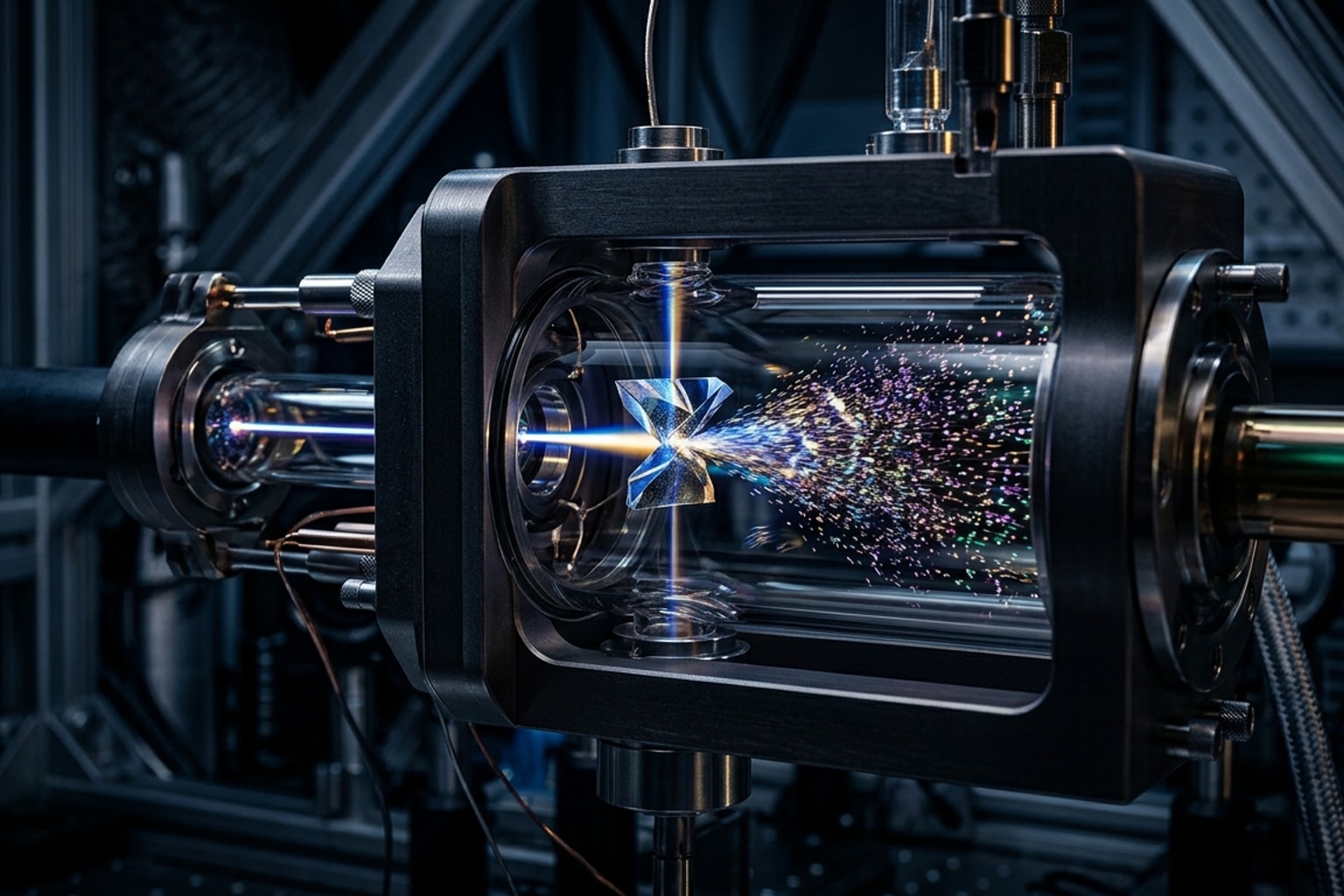
At the heart of this development is a challenge to the everyday language people use for particles. Photons are often described as indivisible, massless packets of electromagnetic energy. The new work asks what the quantum state would become if an extremely fast optical shutter interrupted only part of a photon pulse. In that setup, “splitting” is not like cutting a bead in half. It is a change to the quantum field state.
The surprising part is the mismatch between local appearance and global structure. Near the shutter, the system can look deceptively ordinary, as if there is a photon on one side and a vacuum on the other.
In the full description, Still, the state becomes a superposition with many photon-number components. That tension is the real hook: the math says something far richer is happening than the simple picture suggests.
What to verify
The most important caveat is that this is a theoretical result, not a viral clip of a photon physically snapping into visible pieces. The reports point to a study in Physical Review Letters about a truncated photon and the quantum field consequences of trying to block part of a light pulse.
The next step is to verify the distinction between the metaphor and the actual model before treating the headline too literally.
The next questions are technical but important: what assumptions the shutter model requires, how the state could be probed experimentally, and whether similar reasoning applies to other quantum particles. Independent explainers from physicists will also matter, because this is the kind of result where a memorable phrase can outrun the careful definition behind it.
Source trail
Physicists have described a theoretical case where trying to cut a photon does not simply divide it. Instead, the calculation produces a complex quantum state with many photon-number possibilities.
It is worth sharing because it turns a familiar question, “Can light be cut in half?” , into a clean doorway into why quantum fields are so difficult to picture.
This analysis is based on reporting from Live Science, published on June 17, 2026, and Phys. org, published on June 2, 2026.
Phys. org identifies the underlying publication as Truncated photon in Physical Review Letters, with DOI details linked from its article.