Quick takeaway: A UNSW Sydney team says ultrasound can make espresso-strength coffee with room-temperature water, using about three-quarters less energy than a heated process while tasting close enough that many tasters could not tell the difference.
The strange part is not that people are trying to make cold coffee. Cold brew is already everywhere.
The strange part is that this method is not trying to taste like slow cold brew. It is trying to produce something much closer to espresso, without heating the water first.
According to UNSW Sydney, researchers used ultrasonic sound waves to create an espresso-strength drink with room-temperature water.
The university says the process can reduce energy use by up to 75%, mainly because the system does not need to bring water to espresso-brewing temperature.
That is why the story is spreading. It combines three things people understand instantly: coffee, sound waves, and a large energy number.
Why it matters
The shareable hook is unusually clean: espresso without hot water.
For coffee drinkers, that sounds like a contradiction. Espresso is usually tied to heat, pressure, and a machine forcing water through finely ground coffee.
The UNSW approach keeps the concentrated-coffee goal, but swaps part of the extraction work to ultrasound.
The research appears in the Journal of Food Engineering, and UNSW describes the process as turning a traditional filter basket into an ultrasonic reactor.
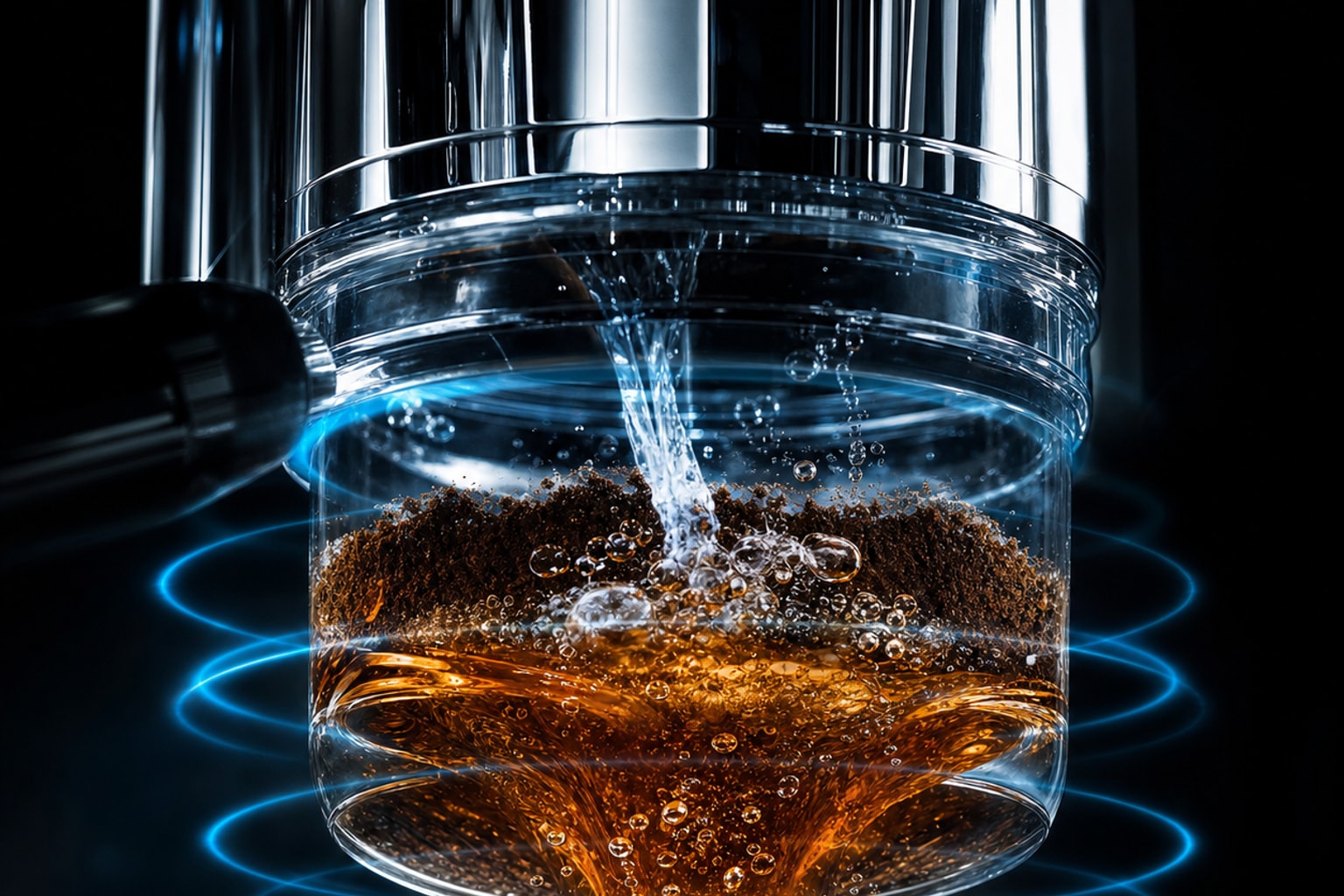
The sound waves create acoustic cavitation, where tiny bubbles form and collapse in the liquid. Near coffee particles, that action can help break open grounds and pull out flavor compounds faster.
That visual is a major reason the story has traction. It is not another abstract energy-saving claim.
It is a clear physical scene: bubbles, grounds, sound, and a concentrated amber shot.
It is worth sharing because it makes a familiar daily object look futuristic without making the science feel impossible.
The catch
The practical question is not whether this will replace a cafe machine tomorrow. It is whether the idea can make commercial coffee production faster and less energy-hungry.
UNSW says the system can produce concentrated coffee in under three minutes, using room-temperature water. That matters most for companies making ready-to-drink coffee, bottled concentrates, milk-based coffee drinks, or chilled products at scale.
In that world, less heat can mean less energy demand, shorter processing time, and different factory economics.
Taste is the obvious catch. A coffee process can save energy and still fail if it tastes thin, sour, or strange.
UNSW says the team ran a blind sensory test with 100 regular coffee drinkers. Participants compared traditional espresso, ultrasound-brewed espresso, traditional filter coffee, and ultrasound-brewed filter coffee in coded cups.
For espresso-style shots, the university reports no significant difference across taste measures and no clear preference for either method.
That does not mean every coffee lover will immediately prefer it. It means the early test did not show a clear taste penalty for the room-temperature ultrasound version.
What to verify
The first thing to watch is scale. A university setup can prove a process, but factories need repeatability, maintenance, cost control, cleaning routines, and consistent taste across many batches.
The second question is energy accounting. The headline saving is about avoiding water heating, but a full commercial comparison should include the ultrasound equipment, throughput, cleaning, chilling, packaging, and any extra processing steps.
The third question is coffee quality across beans and roast levels. Espresso is sensitive to grind size, roast, pressure, water chemistry, and extraction time.
A method that works well with one recipe still has to prove itself across the messy range of real coffee production.
The promising part is that the claim is not built on novelty alone. The mechanism is clear, the sensory test is described, and the industrial use case is specific.