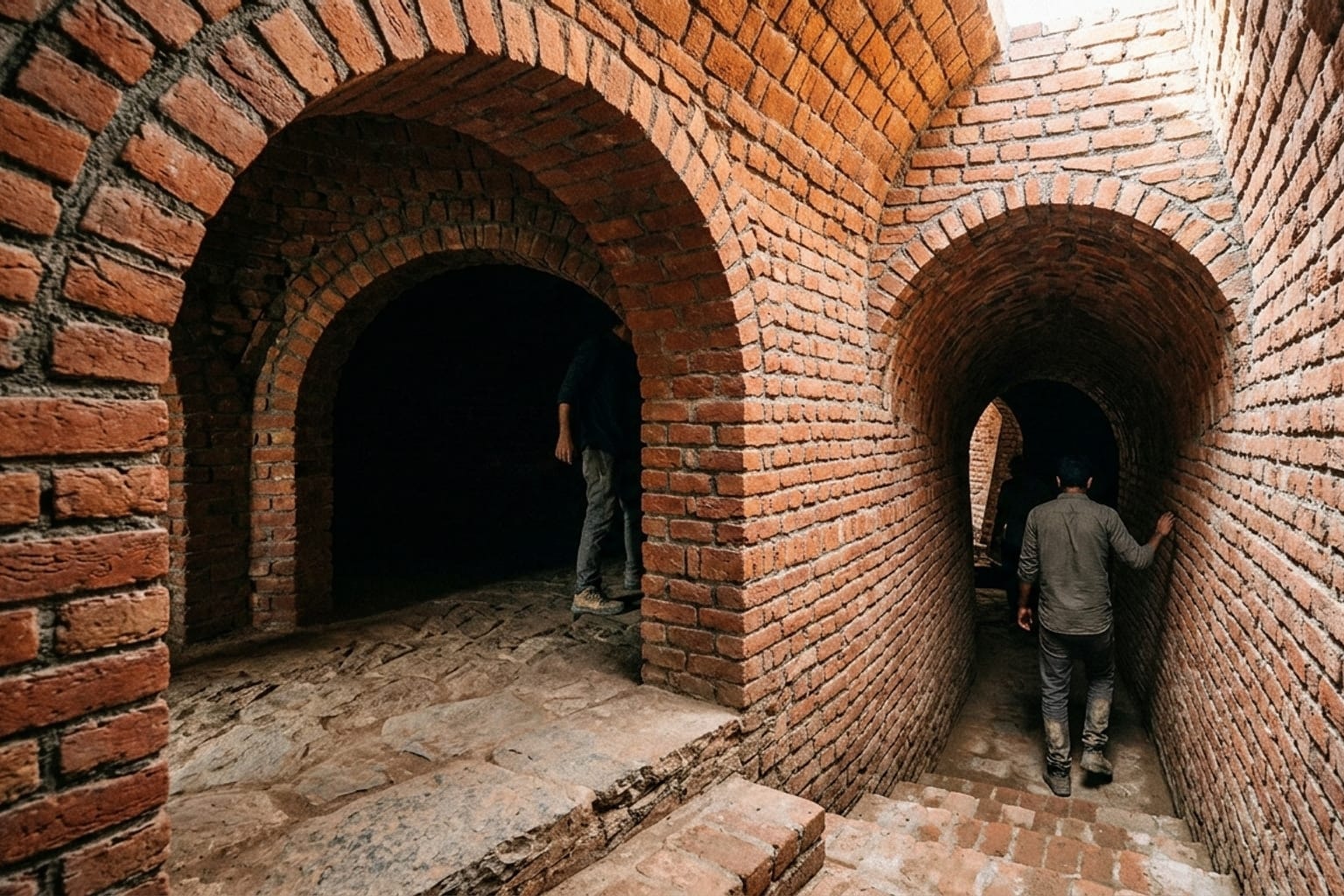
Kaushal Tatiya Architects has completed a new brick residence in India designed to mimic the natural cooling systems of insect mounds. Called “The Anthill,” the house uses cavernous passages and specialized brick chambers to manage extreme heat in Maharashtra.
What happened
The design team at Kaushal Tatiya Architects recently unveiled “The Anthill” in Ahilyanagar, Maharashtra. The house draws direct inspiration from the natural world.
It replicates how ants and termites build complex, self-cooling structures in harsh environments.
Builders constructed the home using extensive, detailed brickwork. The layout features cavernous internal passages instead of standard hallways.
These winding pathways connect various brick chambers throughout the residence.
The architects focused heavily on passive cooling techniques. By studying insect-built mounds, they translated biological thermal intelligence into human architecture.
The structure channels air through its corridors. This natural ventilation system reduces the home’s reliance on artificial air conditioning.
Designboom featured the project as part of its ongoing architecture coverage. The publication also recently highlighted other major global designs, including Herzog & de Meuron’s newly unveiled Al Maha Island masterplan in Qatar.
Why it matters
Extreme heat is a severe and growing problem for residential construction across India. Traditional air conditioning demands massive amounts of electricity.
This strains local power grids during the hottest months of the year.
“The Anthill” offers a biological solution. It uses biomimicry to address modern climate challenges.
Termite and ant mounds maintain stable internal temperatures despite blistering outside heat. Applying this natural logic to human housing could significantly lower daily energy costs.
Brick is an accessible, local building material in Maharashtra. Using standard clay bricks to create advanced thermal designs makes sustainable architecture more practical.
It demonstrates that climate-resilient homes do not always require expensive, high-tech synthetic materials.
The catch
Biomimetic designs often require highly specialized bricklaying techniques. Creating cavernous passages and curved chambers takes far more time than building standard flat walls.
It also demands a highly skilled labor force.
The irregular architectural shapes can complicate daily living. Standard modern furniture does not easily fit into curved brick chambers.
Passive cooling also has hard limits. While winding brick corridors lower the ambient indoor temperature, they may not entirely replace mechanical cooling during severe, prolonged heatwaves.
What to verify
The exact temperature difference between the interior and exterior of the house remains unpublished. Independent thermal testing is needed to confirm how well the biomimetic design actually performs in peak summer.
Overall construction costs are also missing from the initial project release. It is unclear if the complex brick masonry makes the home significantly more expensive than a traditional build.
Finally, the specific construction timeline for Herzog & de Meuron’s related Al Maha Island masterplan in Qatar requires further confirmation.
Source trail
Designboom featured the project, highlighting its [brick chambers and cavernous passages](https://www. designboom.
com/architecture/brick-chambers-anthill-house-india-kaushal-tatiya). The architectural showcase details how Kaushal Tatiya Architects translated insect thermal intelligence into human housing.
The publication’s architecture section also recently covered the [Herzog & de Meuron Al Maha Island masterplan](https://www. designboom.
com/architecture/brick-chambers-anthill-house-india-kaushal-tatiya) in Qatar. Both projects reflect a broader industry push toward environmentally adapted structural designs.