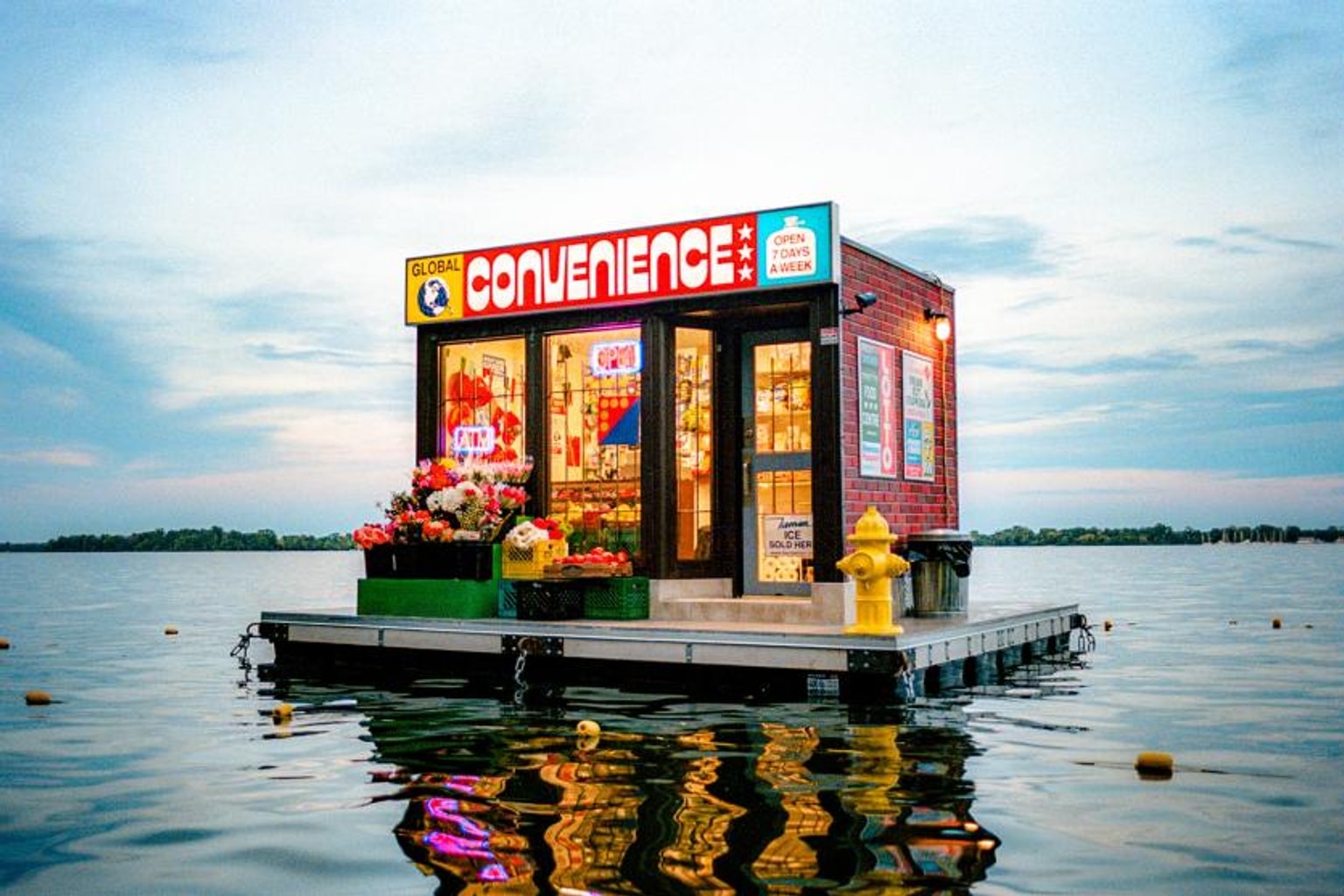
Toronto’s waterfront has recently become the backdrop for a highly unusual and surreal architectural intervention. Floating quietly on the waters of Lake Ontario, a fully stocked convenience store now bobs just out of reach of dry land.
Created by artists Trevor Wheatley and Cosmo Dean in collaboration with the design studio Puncture, the installation takes a ubiquitous symbol of urban life—the brightly lit corner store—and displaces it into the natural, aquatic expanse of the harbour. The structure is solar-powered, allowing it to glow autonomously against the evening sky, creating a striking visual anomaly for onlookers on the shoreline.
Why it matters
Public art that disrupts everyday expectations tends to capture immediate attention, and this floating bodega is no exception. News of the installation began circulating widely following a feature in the design press in mid-June 2026.
The striking imagery of a glowing, isolated retail space floating on open water provides an irresistible visual hook for both local residents and international art enthusiasts. This story is particularly worth sharing because it transforms a completely mundane urban fixture into an evocative, dreamlike spectacle that challenges our relationship with everyday consumer spaces.
The contrast between the hyper-familiarity of a corner store and its completely inaccessible, aquatic setting creates a cognitive dissonance that resonates strongly with audiences. Also, the solar-powered nature of the installation adds a layer of modern self-sufficiency, allowing the piece to operate independently as a glowing beacon in the harbour without tethering to the city’s electrical grid.
The catch
Observers and people are attempting to unpack the conceptual framework behind this inaccessible storefront. By placing a “fully stocked” convenience store out on the water, Wheatley, Dean, and Puncture are prompting questions about consumerism, convenience, and the mirage-like nature of modern retail. The store is described as being “just out of reach,” which subverts the very definition of a convenience store. It is no longer convenient; it is an unattainable display.
People are also curious about the material reality of the installation. Is the stock inside composed of real perishable goods, or are they carefully crafted replicas designed to withstand the humidity and motion of the lake?
Also, the logistics of mooring an entire architectural structure on Lake Ontario—a body of water known for fluctuating conditions and occasional turbulence—raise questions about the engineering involved. The use of solar power to keep the store glowing at night highlights a commitment to off-grid functionality, but it also emphasizes the isolation of the piece.
It is a closed loop, a retail ghost ship that sells nothing and serves only as a visual provocation.
What to verify
While the visual impact of the floating store is undeniable, several logistical and artistic details require further confirmation. Journalists and local authorities will need to verify the exact duration of the installation and whether it will remain in Toronto’s harbour throughout the summer season.
It is also necessary to confirm the permitting process and environmental safety measures involved in mooring a commercial-style structure on the lake, particularly about potential debris or disruption to local waterways. Also, the exact nature of the “fully stocked” interior remains to be clarified—whether the items are authentic retail products or weatherproofed artistic props.
Finally, tracking any upcoming statements from the artists or the design studio will be essential to fully contextualizing their specific thematic intentions about urban displacement.
Source trail
The primary reporting about this installation originates from the art and design publication Creative Boom, which highlighted the project and detailed the collaboration between the artists and the design studio. The piece credits Trevor Wheatley, Cosmo Dean, and Puncture for the conceptualization and execution of the floating store.
Artists Trevor Wheatley and Cosmo Dean, alongside design studio Puncture, have launched a glowing, solar-powered convenience store onto Lake Ontario. Moored just out of reach in Toronto’s harbour, the fully stocked installation subverts the concept of urban convenience by transforming a familiar retail space into an inaccessible, floating mirage.