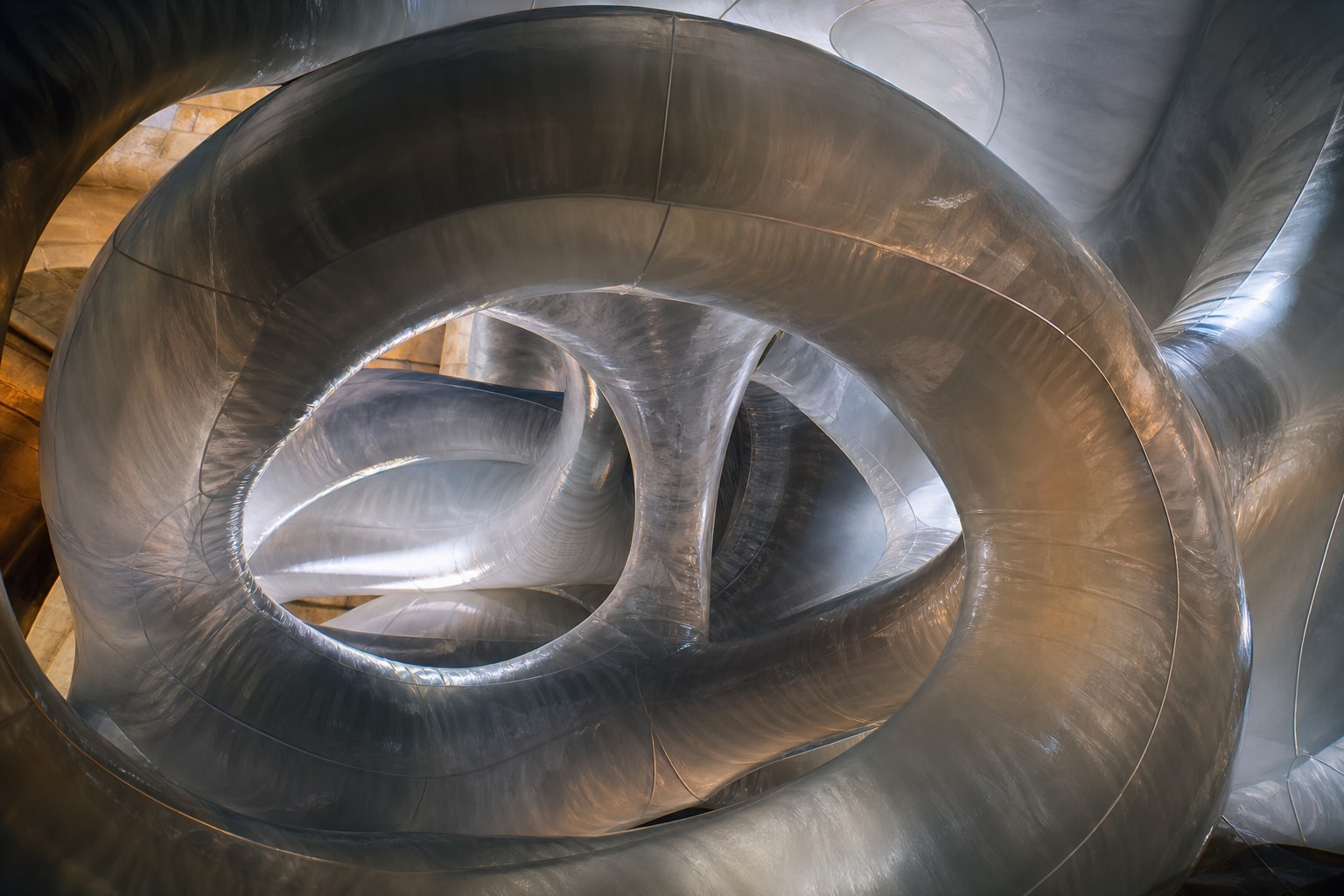
French artist JR has released the first interior photos of his massive installation at Pont Neuf in Paris. The new images reveal a dark, winding tunnel hidden directly inside the inflatable mountain that currently covers the city’s oldest bridge.
What happened
When JR unveiled La Caverne du Pont Neuf earlier this month, the public only saw the outside. The dramatic exterior features an inflatable mountain of fake rock formations rising straight up from the bridge.
These jagged peaks are highly visible from the Seine and the Eiffel Tower. Now, newly released images show the hidden inside.
The interior pulls visitors into a disorienting, cave-like environment. Monochromatic rock-printed walls curve around a central column that descends from the rounded ceiling.
This white, black, and gray passageway feels suspended somewhere between a natural cave and an artificial corridor. The installation relies on more than just sight to build this illusion.
It uses immersive sound and smell to create a fully sensory experience. Thomas Bangalter, a longtime collaborator and former member of Daft Punk, created a custom soundscape for the tunnel.
His audio folds into the darkness, making the winding passage feel even more confusing. Journalist and olfactory curator Sarah Bouasse designed a custom scent specifically for the space.
This unique smell mixes with the dim light and audio to transform a simple walk across the bridge. JR based the entire design on the Lutetian limestone originally used to build the Pont Neuf.
The artist imagined the bridge as if its geological source still lived inside it.
Why it matters
The project successfully shifts the focus away from pure visual spectacle. It asks people to navigate the artwork physically instead of just looking at it from afar.
The cave design intentionally slows down the simple act of crossing a bridge. It encourages visitors to pay closer attention to their immediate surroundings and their own physical senses.
The installation brings Paris’ deep subterranean history directly above ground. It turns the city’s hollowed-out quarry history into a physical space that anyone can explore.
The project remains completely free to the public. JR funded the massive work through the sale of his own art and various private partnerships.
He also collaborated closely with the Christo and Jeanne-Claude Foundation to bring the monumental piece to life.
The catch
The installation did not open smoothly. Strong winds severely damaged the inflatable structure in early June.
This unexpected weather damage delayed the public debut. The structure required immediate repairs before anyone could safely enter the tunnel.
The space is also built to cause mild unease. The dark lighting, strange sounds, and winding walls are intentionally destabilizing for visitors.
Finally, the artwork is not a permanent addition to the Paris skyline. The installation will close entirely on June 28, 2026.
What to verify
Check local wait times before visiting the bridge. Free admission often leads to incredibly long lines for temporary art installations.
Confirm the specific operating hours for the interior tunnel. The massive exterior is visible constantly, but the sensory interior likely closes at night.
Look for daily updates on local weather conditions. High winds could force temporary closures or cause further damage to the inflatable shell.
Source trail
Details and interior photographs originated from a recent report in My Modern Met.
Further context on the artist’s past public projects is available on JR’s official website.