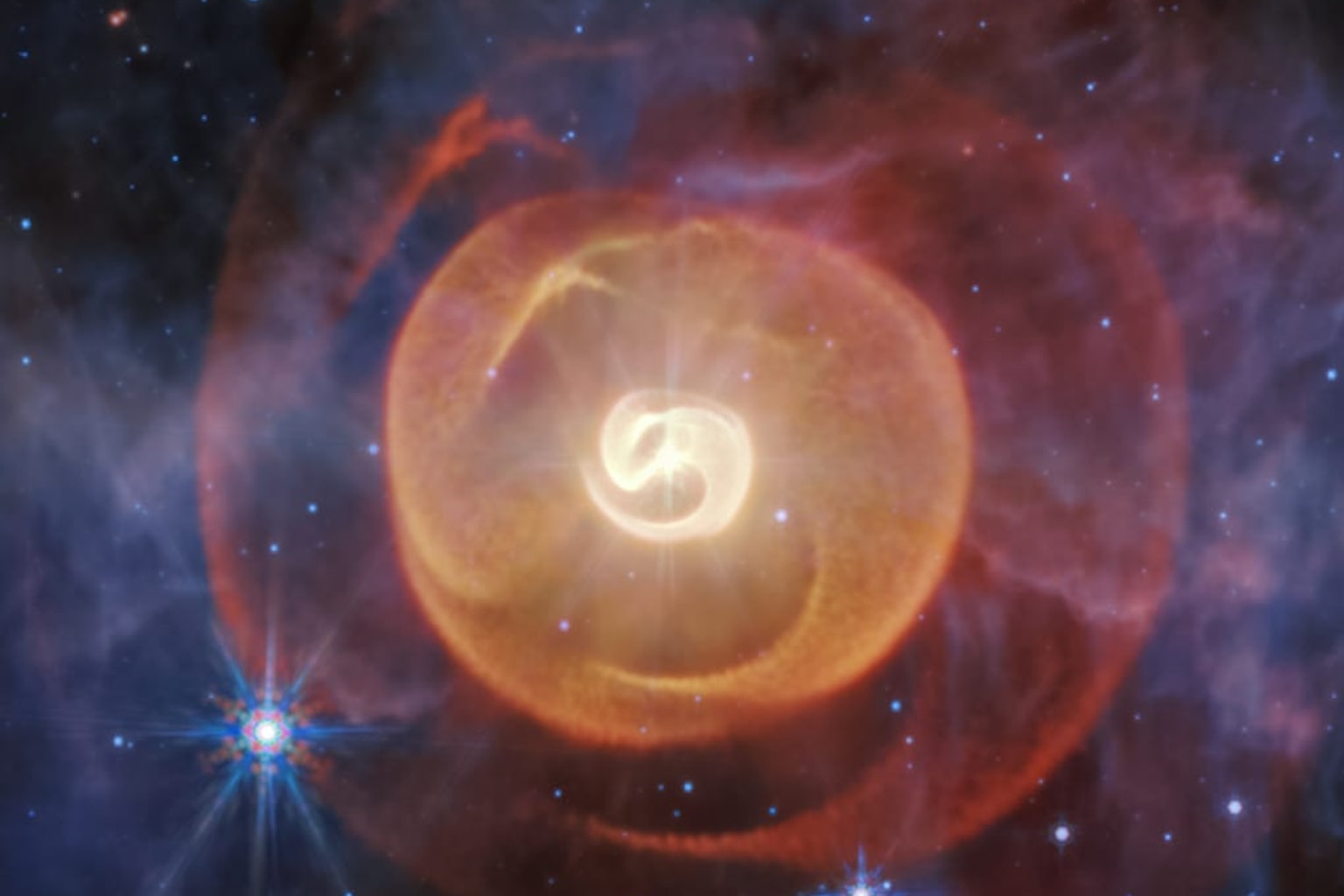
NASA has released a new 223-megapixel composite image of the Cigar Galaxy. The massive picture combines data from the James Webb and Hubble space telescopes, revealing roughly 16.
5 million stars located 12 million light-years away from Earth.
What happened
Scientists used the James Webb Space Telescope to observe the edge-on starburst galaxy officially known as Messier 82. The telescope’s Near-Infrared Camera gathered data across 65 hours of dedicated observation.
The resulting image highlights an incredibly dense cluster of stellar objects. It merges Webb’s new infrared data with previous optical captures from the older Hubble Space Telescope.
Hubble had previously mapped the galaxy’s surrounding structure. Its older technology captured dust grains depicted in red and orange, alongside yellow ionized hydrogen gas.
However, Hubble could not capture the same level of detail as Webb. The newer telescope pierced through the thick dust to resolve millions of blue-white stars hidden underneath.
NASA fellow Adam Smercina called the galaxy a beautiful mess. He noted that researchers still do not fully understand the galaxy’s evolutionary history.
Scientists are currently trying to determine how long the galaxy has been driving plumes of material away from its center.
Why it matters
Messier 82 is undergoing a highly elevated rate of star formation. Researchers suspect a past galaxy merger triggered this intense period of cosmic activity.
The galaxy is currently building stars ten times faster than the Milky Way. Astronomers consider this a short-lived event in astronomical terms, even though the process lasts a few hundred million years.
Combining data from multiple telescopes allows scientists to study these intricate ecosystems in greater depth.
Kristen McQuinn of the Space Telescope Science Institute explained that a single mission cannot answer every question about Messier 82. She noted that marrying datasets expands what researchers can probe.
By pulling datasets from different missions together, the questions astronomers can pose become much more complex. This combined data helps map the galaxy’s distended disk structure.
The catch
Despite the massive 223-megapixel resolution, the new composite image does not show everything in the galaxy.
Researchers note that while millions of stellar objects appear as blue granules, many more remain invisible to current instruments.
The exact mechanics driving the galaxy’s rapid star formation remain unconfirmed. The theory that a galaxy merger caused the activity is currently just an initial speculation by the research team.
What to verify
Look for the raw image files and full-resolution downloads on official NASA portals.
Check for upcoming published research papers from Tufts University or the University of Manchester detailing the star formation rates in Messier 82.
Monitor future Webb observation schedules to see if astronomers plan follow-up studies on the galaxy’s dust plumes.
Source trail
The image and background details were published by This Is Colossal.
Image processing credits belong to Alyssa Pagan at the Space Telescope Science Institute. Additional data was provided by Adam Smercina of Tufts University and Thomas Williams of the University of Manchester.