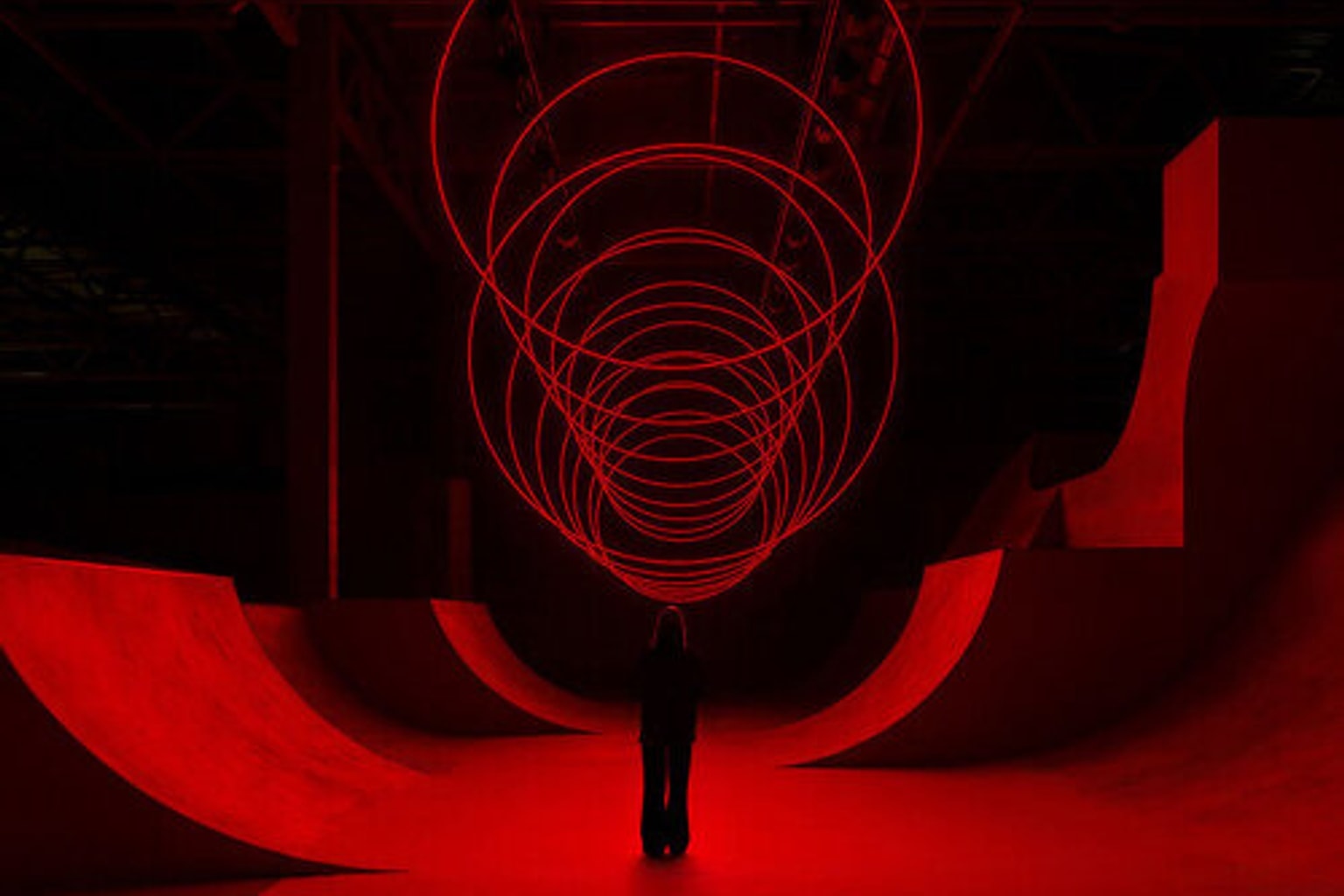
Spanish artist SpY has unveiled a new kinetic spatial installation called Cycles N2. Fifteen illuminated rings shift vertically through the air.
The artwork uses a programmed system of movement, light, and sound to alter the room.
What happened
The piece features 15 separate circles of light suspended from the ceiling. These rings travel up and down in a highly controlled sequence.
The mechanical movement synchronizes directly with a custom audio track. The brightness and rhythm of the lighting also shift in time with the motion.
This three-part choreography constantly redraws the physical space around the artwork. The glowing rings create temporary cylinders, funnels, and waves of light in the dark room.
Image data from the [designboom report](https://www. designboom.
com/art/floating-rings-light-space-spy-kinetic-spatial-installation-cycles-n2) indicates the project is located in Kazan. The installation officially carries the title Cycles N2.
SpY is an artist widely known for large public interventions. This new piece brings his focus on spatial transformation into a controlled indoor environment.
The rings operate as a single cohesive unit. They move together to form complex geometric patterns before breaking apart into chaotic arrangements.
Why it matters
Kinetic art depends on physical motion to create a specific visual experience. Cycles N2 merges heavy mechanical engineering with precise digital control.
This method turns a static architectural space into a fluid, shifting environment. The room never looks exactly the same from one minute to the next.
The project highlights a growing trend in contemporary public art. Modern installations frequently combine industrial machinery with immersive sensory design.
Digital choreography allows artists to treat light as a physical building material. The rings carve out temporary walls and tunnels in the empty air.
The designboom platform tracks these spatial and material innovations across the art world. The site recently highlighted artist Eva Jospin, who crafts entire intricate worlds from cardboard.
Both artists manipulate physical space, though they use vastly different methods. SpY uses intangible light and sound, while Jospin relies on physical paper cuts.
The catch
Kinetic installations demand constant technical upkeep to function properly. The artwork relies on a complex network of motors, suspension cables, and digital controllers.
If one small component fails, the entire piece breaks down. A single stuck motor ruins the precise geometric alignment of the 15 rings.
The visual impact depends entirely on flawless mechanical execution. The illusion of floating light vanishes if the machinery becomes too loud, jerky, or erratic.
Complex spatial installations are also difficult and expensive to transport. Moving the piece requires rebuilding the entire overhead structural grid in a new location.
The heavy reliance on technology makes the artwork vulnerable to software glitches. Power fluctuations can easily disrupt the synchronized audio and lighting cues.
What to verify
The exact venue hosting the installation in Kazan remains unspecified in the primary text.
The mechanical specifications of the overhead cable and motor system need independent confirmation.
It is currently unclear if Cycles N2 is a temporary exhibition or a permanent architectural fixture.
The identity of the sound designer responsible for the audio track is not listed in the initial summary.
The exact dimensions and weight of the illuminated rings require further documentation.
Source trail
The details originate from a recent feature published on [designboom](https://www. designboom.
com/art/floating-rings-light-space-spy-kinetic-spatial-installation-cycles-n2).
The publication’s summary outlines the 15 rings and their choreographed system of movement.
Embedded image URLs confirm the title Cycles N2 and suggest the Kazan location.
The source platform also features related contemporary art coverage. This includes the excerpted mention of Eva Jospin’s cardboard sculptures.